Friday, May 27, 2011

Textiles, Italian style

There's been a lull on Pearl the Squirrel, and I confess it's because I've been away. Yup, I just left home for 12 days...the longest stretch in many a year. I was fortunate enough to accompany my husband to a meeting in Italy, and then we stayed on for another week and met up with my daughter and her husband and had an absolutely fantastic time. Aside from getting lost on the autostrade a few times, all went well (we even got bumped up to business class on our flight over and those luxurious seats make it possible to actually sleep—what a fantastic treat!).

In addition to all the glorious scenery, churches, food, etc., I found myself drawn to the way Italians hang their laundry on clotheslines they string ingeniously from window frames, shutters, etc.

I have a real thing for my own clothesline, hanging clothes when using the dryer would be much more efficient. Although I thoroughly enjoy the fact that I'm not spending money or energy when I use my clothesline, there's something about all aspects of hanging out laundry—the way the colors of wet clothes are deep and saturated, seeing fabrics fluttering in the wind, and getting to fold them up and pop them in my wicker clothes basket, often no longer in need of ironing—that warms my textile-lovin' heart.


So I give you my Italian laundry series...


Monday, May 9, 2011

Feed Sacks, Continued

Thought those of you who read the Etsy feed sack post might enjoy a few more photos: The exhibit was sensational and Mike Zahs knows so much...I kept encouraging him to write it down, because it will be a shame if his extensive knowledge is lost. He's obsessive, in the best possible way, and one thing I really loved was that he so admires the women who used every last bit to make sure their families were clothed and comfortable. He's even got a doily crocheted from the strings used to hold feed sacks closed.

Enjoy, and plan a visit to Ainsworth the last weekend of 2012!

This piece contains 561 squares of 134 different sacks.

Feed sack from the 1950s with sailor doll. Sew, stuff, and enjoy.


The Corn of Tomorrow, Today
Border prints above. Some of Zah's 31 new feed sacks below.

One crate full from Zah's collection. He has nearly 50 crates.
Three colorways of a single feed sack pattern
A book of feed sack sewing ideas
A fantastic spider web quilt made with solid and striped sacks
Ainsworth Opera House: tables set for lunch and dinner meal served as a fundraiser

Friday, May 6, 2011

A Case of the Blues

I've always had a thing for blue. When I was young it was hands-down my favorite color. While I'd no longer say that was true (because I can no longer imagine narrowing myself to ONE color), I still find myself drawn to it again and again. So when I got an opportunity to write about indigo, I was pleased, both visually and as a writer.

The article appears in the most recent issue of Stitch. I tell you, I get started researching these things and become so fascinated...indigo has an ancient history as a treasured dye, and like so many textile-related things, affected national economies and policy worldwide. In addition to learning about indigo, I had the opportunity to finally write about shweshwe, a fabric that I've had a real obsession with for quite a few years.

I first encountered shweshwe in one of my favorite quilt shops—Eagle Creek in Shakopee, Minnesota. At first glance it reminded me of an old-fashioned calico. But the minute I picked up the bolt I realized it's another beast entirely. First, the fabric is only 36" wide. The second striking thing is that it's as stiff as a board (it washes up to a lovely softness). Intrigued, I bought a few fat quarters and used them in a quilt I made for my aunt. (The shweshwe is mixed in with many other blue fabrics above. The pattern is from a several-year-old Quilt Sampler. If you're interested, leave me a message and email address and I'll let you know which issue it's in.)

I could find little out about the fabric until I found the folks from Marula Imports at Quilt Market. There I learned that shweshwe comes not only in blue, but red and brown (blue is still my favorite). It was first created by the Dutch and shipped to South Africa for sale, where it was snapped up by locals. In 1980 production moved to South Africa. The Da Gama company, which produces the 3 Cats line (check the back of the fabric for the distinctive logo), is environmentally and socially conscious, providing jobs for many skilled and unskilled workers (it's 40 percent worker-owned) and uses cotton from an emerging South African market. So not only is it lovely, but you can feel good about using it.

The only problem I've had with it is that the dye will run for a long time if not properly laundered. Marula has great washing tips on their web site, along with all sorts of background and other info on shweshwe.

A few years back a friend of my husband's casually mentioned he was going to South Africa and did I need anything. I mentioned my love of this fabric and as it turned out, this non-sewing, pediatric intensive disease specialist ended up visiting quilt shops and learning all about shweshwe. And he brought me back the lovely yardage above. Not sure that he's a converted quilter, but in the end he didn't seem to mind tracking it down for me. What a pal!

Thursday, April 28, 2011

All hail the royal nuptials!

So, let's hear it for Kate and William, who must not only experience the jitters that plague every couple about to make a life-long commitment, but have to pledge their troth in front of millions, including people crazy enough to get up at 4 a.m. to watch. And think about the walk down that aisle...I always watch the Oscars and marvel at the actresses who manage to make it up the stairs in heels and trailing gowns to accept their award. Imagine sashaying down that long gangplank (er, aisle) at Westminster, knowing that half the people were cheering for your uprightness and the other half (all those who imagined THEY'D be marrying the Prince) so wanted you to fall on your tush.

I have to admit that when we lived in England in the mid-80s I told my daughter (then 3 years old) that she'd be marrying the Prince someday. I even showed her Buckingham Palace, her future abode. Instead, she chose to marry three years ago...she found her own (American) prince. And I had enough trouble figuring out what to wear to their wedding...thank God I don't have to worry about a hat suitable for royal nuptials! (Thanks to my friend Susie, who brought me the lovely Kate and Will tea-towel, direct from London.)

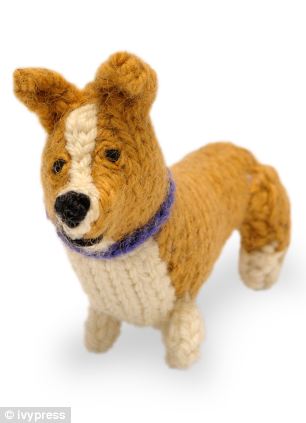
 If you want to stay up all night in preparation for the festivities, you just might have time to knit the Royal Wedding. These fantastic figures are from Knit Your Own Royal Wedding, a book by Fiona Goble, who apparently also wrote Knitivity, a volume with instructions for knitting nativity scenes. I love that she included a royal corgi!


Best wishes to Kate and Will. May they surpass his relatives in every way (including marital bliss).


Wednesday, April 20, 2011

More monkeys (and other critters)

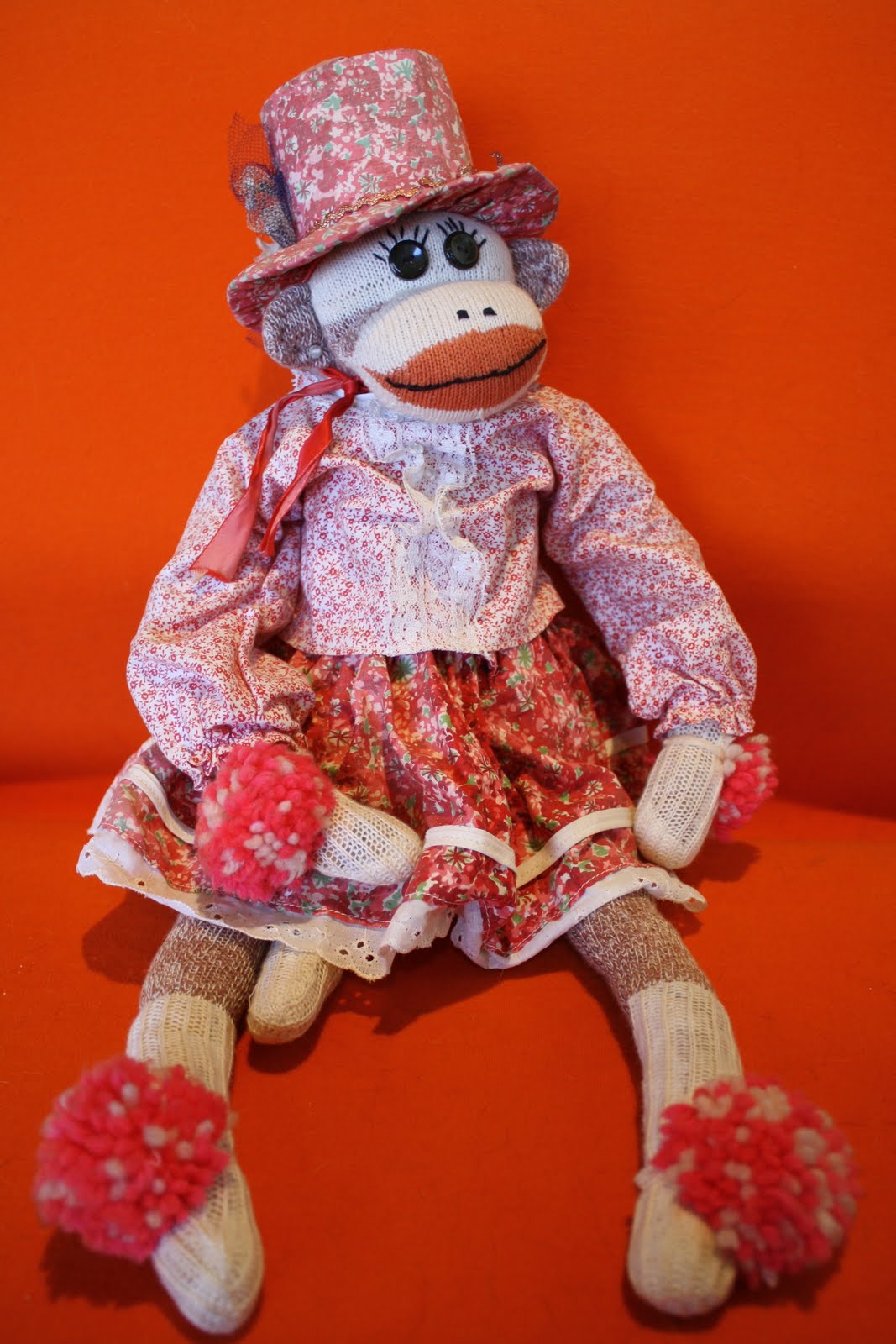
Thought you might enjoy seeing a few more of the sock monkey photos I shot for this week's Etsy post. These are from the collection of Todd Thelan, owner of the fantastic Artifacts. He has between 150 to 200 and his collection has grown over the years. In no particular order I give you more monkeys:


Monday, April 18, 2011

A Chip Off the Old Sock: The Road Trip

It was back in December that I learned that the official socks for creating sock monkeys are made in Iowa. The Etsy story that appeared today has been planned since then, but it wasn't until three weeks ago that Emily Martin and I took a road trip to Osage and Fox River Mills. Of course we felt it was necessary to take a sock monkey along for the ride and so my orthopedically challenged monkey, Jockoline, rode safely in the back seat.

 We stopped along the way to see Iowa's Largest Frying Pan (in Brandon), to gas up, and for lunch at the Teluwat restaurant (seriously good pork products).
Gassing up in Floyd

Emily shares the menu with Jockoline (she can't read)
After dining, we found Fox River Mills. You'd think that given it's the largest employer (around 200 employees) in the county that wouldn't have been hard, but somehow we got lost and had to ask people who were outside raking their lawns for directions. Once there, I made Emily leave Jockoline in the car (Emily is shameless, but I had to remind her I was there for professional reasons and walking in with a sock monkey might have clued them in to my true nature).
Sock critters from the Fox River Mills collection
We were greeted by Mike (PR) and Rebecca (who self-identified as the VP for Monkey Business) and taken to a conference room where they'd laid out sock monkey photos from their history files, along with examples of socks and monkeys they had in their collection. It was a fascinating tale (see Etsy story for background) and I loved the way they embraced the tradition.

 Along the wall of the conference room was sock after sock...Fox River produces 140 styles, but the original Rockford Red-Heels are one of the best sellers (Rebecca said some people even wear them).


After our history lesson, Mike took Emily and me on a factory tour. There is something so magical about a the interwoven nature of machinery and workers on a factory floor (The lede I wrote for this Etsy post is about what I saw at Fox River Mills.) The factory was huge and spotlessly clean. (Emily noted later that she'd just been reading about the Triangle Shirtwaist Factory fire and that one of the things that made it so flammable was that everything, including the workers, was covered with lint. At Fox River each knitting machine had a suction tube that was collecting lint and moving it overhead to an area where it was recycled for stuffing. Green technology and recycling efforts are a big part of the philosophy of the mill.)
Newly knitted sock before it's sucked into a pneumatic tube

Socks await toe-sewing
Hundreds of knitting machines turned out sock after sock, and these were sucked overhead in pneumatic tubes, inspected and sorted. Stacks awaited the workers who readied the socks for the machines that stitched the toes. Enormous laundry facilities took care of the washing and drying and then socks were stretched on sock-shaped forms and put through an iron/steamer to make them flat and tidy. Finally they were folded and fed into a machine that labeled them and inserted the plastic loop on which they hang on store walls. Throughout, giant, wheeled bins held socks awaiting the next step of the process. We also got to see the warehouse and area where they sell socks directly to the public (via their online store). A totally fascinating afternoon.
Emily inspects an older knitting machine

Sock monkey swag
I am a major fan of cozy socks and was fortunate to be given a sample of one of Fox River's light hiking socks and I'm a convert. Not only am I so happy to be able to support an Iowa business, but I'm thrilled that I'll be so very comfortable doing so. I also got a copy of their pattern book and plan to make a sock critter one of these days. I'm thinking a dachshund might be just the thing.

Next post, I'll share some photos of Todd Thelen's sock monkey collection that I photographed for the Etsy post. Lots more good monkeys!