Tuesday, March 30, 2010
The Storque delivers!
Okay, I can't help but brag a bit. Through a series of personal and writing connections, I got asked if I'd do some blogging on quilt-related topics for Etsy. I was thrilled to have the opportunity, particularly because it came with some freedom in terms of topics to write about.
My first post for The Storque is up and I couldn't be happier. The folks at Etsy are terrific to work with and it was an interesting experience to think more visually and locate appropriate photos. (I'm spoiled in that I work with terrific photographers and designers in my day job, who typically prefer that editors deal with the words and let them deal with the images.) I also was once again treated to the generosity of spirit I find in so many quilters...the women I contacted about quotes and photos were so passionate about Modern Quilting and so prompt in getting back to me. The entire experience was a pleasure.
Check it out: Modern Quilter Meet-ups: The Quilting Bee Comes Full Circle
Wednesday, March 24, 2010
Check it out

Yes, I'm with you...the lamest of headlines...but I've had kind of a crazy few weeks. Let's just say I'm grateful for modern medicine! Fortunately things seem to be headed in the right direction now.
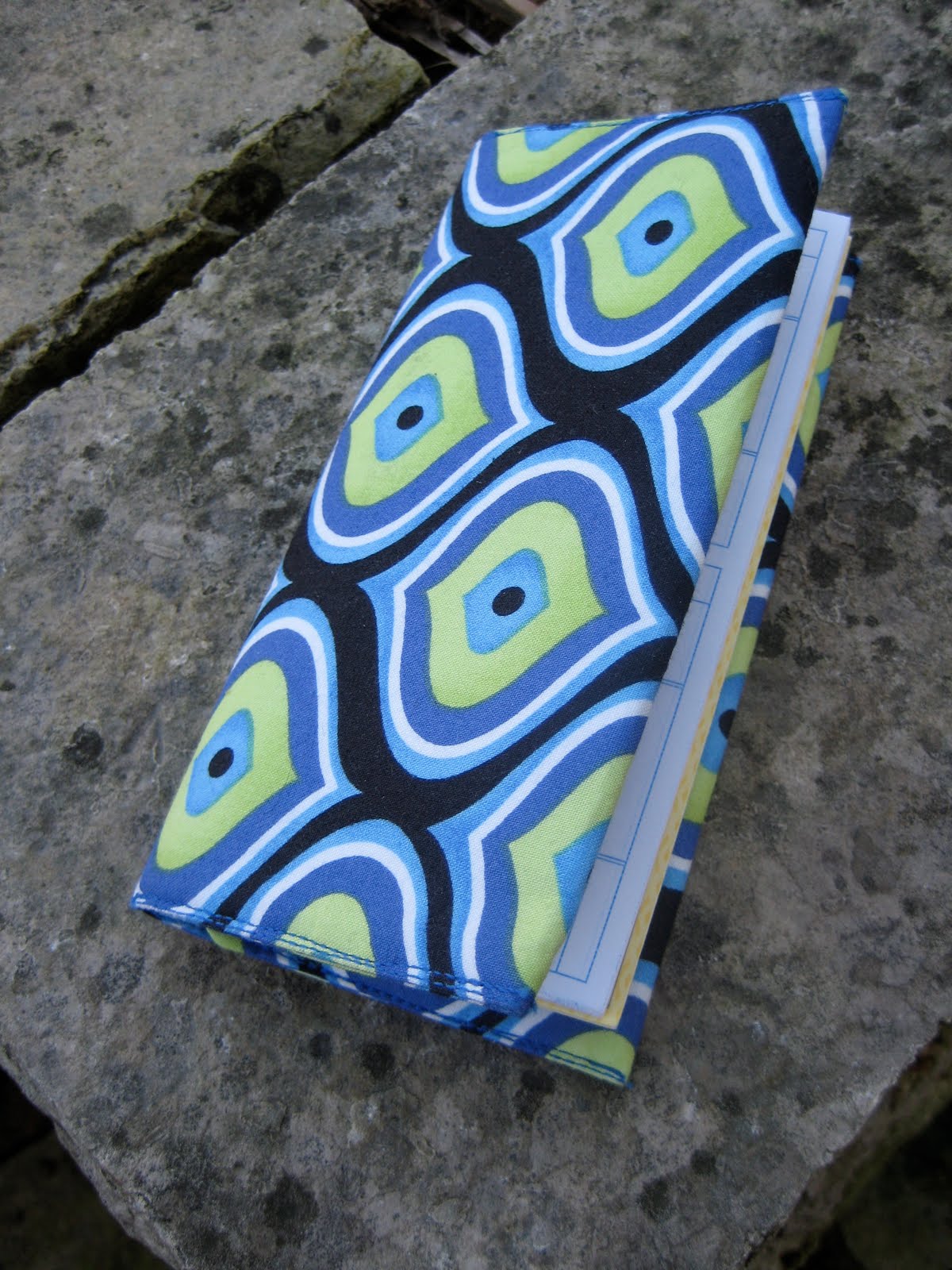
Before it all started I decided that there was no real need to continue using my checkbook cover, which had once been very chic and lovely, but was now just some falling-apart paper and plastic. so I went online, looking for some of those fabulous tutorials that people so generously post. What I love about the myriad tutorials available is that they remind me of the many ways to get something done—that there are plenty of options for constructing the cover and no checkbook police will be hauling me to the pokey for doing it wrong.
I first picked a very floral red and pink Kaffe Fasset fabric, but decided I should go for something more gender-neutral, given that it's the checkbook I share with my husband. So I found this great fabric I'd bought at Hancock's of Paducah, on my way home from John C. Campbell in January.(I've somehow cut the name on the selvedge completely off and have no clue who designed this fabric—any readers have any idea?) I used a bubbly batik scrap for the inside fabric. Sadly it barely shows, but I know it's there and that the fabrics combine nicely.
Thursday, March 11, 2010
Textile translations
I'm a fan of the American Craft Council and managed to find time to read their latest email. It linked to a blog about the American Craft Council show that was held in late February in Baltimore and the Awards of Excellence given to a chosen few participants. The Baltimore show is a granddaddy among these amazing juried craft shows—when I lived in Northern California I used to attend the show at Fort Mason in San Francisco and was always knocked out by the creativity and workmanship of the participants.
At any rate, this year's awardee in fiber is a weaver named Gretchen Romey-Tanzer. As a former weaver, I'm always interested in seeing what's new in the world of warp and weft, so I clicked on her website. The jeweled colors and simple elegance of her work make it evident why she's a winner. It's also an example of the way using quality materials pays off: the reflective quality and depth of color in her cotton yarns makes the pieces glow.All this is to say that when I saw her multiple-paneled pieces, I was struck by how that technique might be translated into quilting. I've been writing about modern quilting of late, and the graphic quality and use of solid blocks of color in Romey-Tanzer's weavings echo the sensibilities of many contemporary quilts. Make sure to check out her other work for inspiration! (All images by Gretchen Romey-Tanzer, reproduced here with permission.)
Sunday, March 7, 2010
Over there
During my junior year of college, I had the amazing good fortune to spend the first half of one semester in Florence and and the second half in London. We studied architecture, art history, and theater. Was I lucky or what?
‘
At the End of the Day’, hanging, Natasha Kerr, 2007. Museum no. T.43-2008
In London I discovered the Victoria and Albert Museum. It was the first time I realized that people preserved and studied textiles like they studied the Medici Chapel in Florence or the paintings of Whistler at the Tate in London. I spent hours just hanging out there, perusing the exhibitions, "paging" through the textile files, incredulous at what anyone who walked in off the street could access. It's remained one of my favorite museums.
Bishops Court quilt, Unknown, 1690-1700. Museum no. T.201-1984
My camp friend Susie just pointed out that there's a quilt exhibition starting this month at the V&A. The web site has some great info, including a curator's blog (can you imagine having that job?) and description of the exhibition. There's even a free Amy Butler quilt pattern to download (although I'm not quite sure why they didn't pick a British quilter for this...after all, Amy's Midwest Modern, right?).
Check out the web site, and if you're lucky enough to be heading to London-town, slot a visit into your schedule.
‘

At the End of the Day’, hanging, Natasha Kerr, 2007. Museum no. T.43-2008
In London I discovered the Victoria and Albert Museum. It was the first time I realized that people preserved and studied textiles like they studied the Medici Chapel in Florence or the paintings of Whistler at the Tate in London. I spent hours just hanging out there, perusing the exhibitions, "paging" through the textile files, incredulous at what anyone who walked in off the street could access. It's remained one of my favorite museums.
Bishops Court quilt, Unknown, 1690-1700. Museum no. T.201-1984
My camp friend Susie just pointed out that there's a quilt exhibition starting this month at the V&A. The web site has some great info, including a curator's blog (can you imagine having that job?) and description of the exhibition. There's even a free Amy Butler quilt pattern to download (although I'm not quite sure why they didn't pick a British quilter for this...after all, Amy's Midwest Modern, right?).Check out the web site, and if you're lucky enough to be heading to London-town, slot a visit into your schedule.
Thursday, March 4, 2010
Wanna feel my fabric?
If you're reading this blog, I know you love fabric (or you're my dad). And if you're not my dad and are addicted to textiles, we have a lot in common.
That said, I'm a big proponent of shopping locally. I get a little annoyed by sewers who want to buy everything online and then are surprised when the local quilt shop has to shut its doors. While there are many amazing online businesses, there is nothing like taking a project into a store and saying "I don't get it" and having them help you. Or taking a class so that you get it in the first place.
Fortunately for my local shops (Home Ec, Common Threads, and Pine Needles), I'm a promiscuous fabric buyer. I purchase from all three local and semi-local shops AND from online vendors.
Today the Fed Ex guy stopped by my door. Pearl growled and then barked at his knocks and I was a little annoyed...I'm supposed to be working, after all. But then I opened the package he'd left on the top step and out came two large zip-loc bags filled to the brim with fabric folded in the tidiest squares. The colors were rich and the prints better than I'd hoped. And best of all, they'd been marked down 50 percent...totally my kind of shopping.
Fortunately for my local shops (Home Ec, Common Threads, and Pine Needles), I'm a promiscuous fabric buyer. I purchase from all three local and semi-local shops AND from online vendors.
Yes, yes, of course I have far too much fabric. But I have so few other vices that I don't even feel too awful about it. And every time I take a class or learn a skill I'll see a new fabric (or maybe an old one I've loved but couldn't figure out how to use) and decide it would be just the thing for a Birdie Sling or a wonky house.
In the case of today's delivery, I was harkening to Mary Lou's advice to include cheddar fabrics in one's quilt. And these purple and blue veggies will be incredible potholders, a la Peg's pattern at Common Threads. And then there is enough of a couple to make a Birdie Sling and to use as a border for a quilt I've got started...
So let's hear what makes you buy fabric—do you buy for a specific project, or do you buy because you see a particular piece you can't resist?
P.S. Anyone have a clue as to why the font looks different, despite the fact that it's the same font and size as in the previous post?
In the case of today's delivery, I was harkening to Mary Lou's advice to include cheddar fabrics in one's quilt. And these purple and blue veggies will be incredible potholders, a la Peg's pattern at Common Threads. And then there is enough of a couple to make a Birdie Sling and to use as a border for a quilt I've got started...
So let's hear what makes you buy fabric—do you buy for a specific project, or do you buy because you see a particular piece you can't resist?
P.S. Anyone have a clue as to why the font looks different, despite the fact that it's the same font and size as in the previous post?
Saturday, February 20, 2010
The better half
Yet I've never felt the same fondness for tools of the trade that she does. I'm not particularly mechanical and think that sometimes I get so caught up in trying to make a gadget work perfectly that I don't actually get any sewing done. So I just use my tried and true methods, again and again.
Last fall I went with my neighbor Pam to the AQS show in Des Moines. Pam was in charge of the "Sewing Tools" demo for the quilt guild and so eagerly listened to the spiels at each booth. Where I would have just breezed through, checking out quilts and fabrics and publications, I hung in there with her. And along with Pam, I ended up buying the Clearly Perfect Angles (CPA) tool. (Just fyi: I have no affiliation with this company.)In my previous post I mentioned learning nine ways to make half-square triangles. One of them involves drawing a line down the diagonal of one square, layering it atop another square, and then sewing two seams, each a quarter inch from the drawn line. You then cut the piece in half, along the line you've drawn and you've got two half-square triangles.
With the CPA, you apply an acrylic template to your machine bed and then just use the guidelines printed on it—no need to draw a line on the diagonal, just align your squares' point with the line on the template, stich, turn it over and do the same on the other side of diagonal, and voilĂ„ (see, not mechanical...I can't even get the correct accent over the "a"). I find that I use that nice line all the time, not just when I'm making half square triangles, and it helps me keep things nice and even. The photo at the top shows this most clearly.I know it's completely possible to use electrical tape to make a seam line on your machine bed, but I love the multiple lines on this thing. My only complaint is that the acrylic doesn't adhere to the wooden portion of my sewing table. But for the most part, it's great.
And I just checked their web site and they're half-price right now. It might mean they're about to release something newer and cooler, who knows? But I sure do enjoy this tool. And since I've embarked on a quilt that uses gazillions of half-square triangles, it's been a real time-saver, making chain-piecing even quicker than it already is.
Friday, February 12, 2010
When the means justify the end...
I had some sewing time this past weekend, and rather than diving into my house quilt, I decided to wrap up some UFOs that had been lingering in my sewing room for months. Two baby quilt tops needed finishing and I enjoyed piecing together fabrics I had lying around to create ample-sized backs. (I'm waiting for a shipment of 505 Spray to sandwich them together. I'll share them once they're quilted.)
The other unfinished project I had was a table runner from a class sponsored by my local guild. In November I took part in a day-long workshop from Ilene Bartos, a teacher from Des Moines.
Now, I admit that I was not all that excited about this class. The finished project didn't really excite me, but I know how hard the program committee members work to bring in a range of speakers and teachers, and how important it is that members attend. So in the name of supporting the guild and spending the day with some very nice women, I signed on.
The class was a reminder of something I touched on in my post on Mary Lou Weidman's class. I'm a product-oriented person and at the end of my efforts I like to have a "thing" I can hold in my hand.
I'm not good at leaving things unfinished: a realtor once told me, when I insisted on seeing every last house in my price range on the market, that I had the strongest "drive to completion" she'd ever seen. (I took it as a compliment, but in retrospect I think she was saying "Enough, already!")
In that drive to completion, it's easy for me to lose sight of the process. And I think that leads me to shy away from classes that features an "end product" I'm not in love with or that I think I might not be good at.
This would be true with Mary Lou's class: I think I can't draw, so I wouldn't be good at figurative quilts. But in that class I realized (duh!) that half the reason to take the class is to learn something new, to try a technique or color combination that takes me out of my comfort zone.
In the case of Ilene's class, I wasn't wild about the project and ultimately was not happy with my fabric choices (too many mid-range fabrics, with tiny patterns, that didn't stand out from the overly busy background). But boy did I learn!
The maple leaves in the runner were made using nine different techniques for creating half-square triangles. Now this may sound dull to some—and you know who you are, Anne K.—but I loved re-learning that there's no one right way to do anything in quilting—there are myriad choices and it's perfectly fine to do what suits you best. And I surprised myself by liking the bias method of making half-square triangles. My bias against bias comes from my early days of sewing, when I had to straighten my fabric by pulling a thread all the way across the weft—bias was just one of those scary things I didn't really understand. How I hated all that fussiness. But this bias wasn't at all tedious.So, I'm not proud of the product I share with you...but I'm proud of the process. I also learned to couch a metallic thread, and while I'm not sure that I'll be doing it again anytime soon, it's taken the fear factor out of yet another term for me to have done it once.
Pearl wondered what the heck I was doing dragging quilt-y things out into the snow and refusing to let her play with them. So she watched from a safe place.
Wednesday, February 3, 2010
Matters of the heart
There's still a little sewing time before Valentine's Day, so here's something you could try.After my last post I got some very nice (and much appreciated) comments from readers. One of them was Carol, a quilter from Michigan who shares my fondness for making dolls and writing, among other things. I visited her blog, and just loved a recent post on using scraps to make a Valentine table runner.
I thought you'd enjoy seeing the wonderful results of her decision to clean up a scrap pile. While the post isn't exactly a tutorial, it has some great photos of how to "make fabric" from scraps and the really cheery table runner that resulted. It's a great idea with all sorts of applique, sashing, and border possibilities. Thanks so much Carol for sharing your work with Pearl the Squirrel readers!
Thursday, January 28, 2010
Making a house away from home
Okay, it's time to share some photos of the quilting class I took at John C. Campbell last week. The class was taught by my buddy Mary Lou Weidman (center, in the photo below), a Washington-state quilter I got to know when I interviewed her for a story in American Patchwork and Quilting.


She and I hit it off on the phone, and the conversation I told her would probably take 15 to 20 minutes ended up lasting an hour. A few emails later she asked me to join her in Houston for Quilt Market. I was stunned, and being a basically shy person I told my husband "I could never do that! I've never even met her." He wisely said, "You can't NOT do that!" and he was right. Not only did I get to know and love Mary Lou and her wonderful friend Mel, attending Market opened numerous doors opened for me. She knew that would happen and in her very open-hearted and generous way, she wanted to create opportunities for me, a near stranger. I am incredibly grateful.
All this is to say that Mary Lou is definitely a "friend in fabric," par excellence. But she's also a teacher who travels the country at a crazy pace, teaching quilters who frequently take classes from her multiple times. So when she told me about John C. Campbell, I thought it was the perfect chance to finally learn her methods.

Mary Lou is all about having fun. But she's also a trained artist, and I learned not only to put together a quilt using her free-form "Hoochy Mama" block technique (you can see some in the picture third from the top), but to think about value and contrast in choosing fabrics. I learned that there is a method to her madness. Carol, a second-timer in Mary Lou's classes, commented that Mary Lou's seemingly wild quilts really do have a definite color scheme and though it took me awhile to see it, Carol is absolutely right.
After spending a week with Mary Lou I learned to step back and consider how a particular fabric or color worked with others around them. Her quilts, which might have seemed to me at first to be a happy accident, or created by someone on the fly, are actually pieced and stitched with a studied attention to the relationships of color, pattern, value, and contrast. While Mary Lou does design as she goes, she's also got a clear sense of what does and doesn't belong in proximity, and how to balance sizes, shapes, and patterns.
Another thing I love about Mary Lou is that while she thinks hard about how to make the best quilt, she's not a stickler for perfection. When it came time to stitch together individually created houses, adding a piece of fabric or better yet, a "strata" of pieced fabrics to make them fit was just fine and often could be used to design advantage. This was not an easy thing for many of my classmates to do, and it was challenging even for someone like me who is a staunch advocate of the School of Good-Enough Quilting, (initiated as I was early on by my friend Anne). But as you can see, our quilts grew throughout the week as we became bolder and more willing to go out on a limb. I've included just a couple class members quilts along with my own. To see more, you can check Mary Lou's site at Mary Lou and Cherries Too.

My quilt became a half-Iowa, half-California house, and I'll have bits of each place incorporated. I chose to include the owl who hoots in my backyard daily on the Iowa side (he'll eventually be sitting on a big tree) and plan to applique the Golden Gate Bridge, which I could see from my Berkeley home, on the Calif. side. Ambitious, perhaps...I've included an early photo and one from the end of the week, so you can get an idea of the way the houses changed as the week progressed.


The idea with these quilts is that in the windows and doorways we'll applique people or pets or things that are important to include in our houses, so there is still much to be done on them all. But you can see we got a great start. And we kept reminding ourselves that while Mary Lou can whip out a quilt in two to three weeks, others have worked on these for years at a time...it's important to remember the process is as important as the product.
One quilt that was different than the rest belonged to Jessica, a student host and class member who was making her first quilt. (She's the "youngster" on the floor in the group photo.) She used all Hoochy Mama blocks and completed a pieced front and back. (It's the one with green stars and orange border.) Susan (whose quilt is fourth from the top of the page and includes her dog Murphy, and who also can be seen sitting behind her sewing machine, amidst her stash) offered to take it home and quilt it on her longarm...such a kind and generous thing to do, since she told me earlier that she had 35 quilts waiting for her to finish at her shop!
In addition to meeting some wonderful folks (including Mary Lou's assistant, Kathy, about whom I'd heard so much) we had terrific facilities: great lighting, comfortable chairs, a big table to ourselves, and windows on two sides of the room.
She and I hit it off on the phone, and the conversation I told her would probably take 15 to 20 minutes ended up lasting an hour. A few emails later she asked me to join her in Houston for Quilt Market. I was stunned, and being a basically shy person I told my husband "I could never do that! I've never even met her." He wisely said, "You can't NOT do that!" and he was right. Not only did I get to know and love Mary Lou and her wonderful friend Mel, attending Market opened numerous doors opened for me. She knew that would happen and in her very open-hearted and generous way, she wanted to create opportunities for me, a near stranger. I am incredibly grateful.

Mary Lou is all about having fun. But she's also a trained artist, and I learned not only to put together a quilt using her free-form "Hoochy Mama" block technique (you can see some in the picture third from the top), but to think about value and contrast in choosing fabrics. I learned that there is a method to her madness. Carol, a second-timer in Mary Lou's classes, commented that Mary Lou's seemingly wild quilts really do have a definite color scheme and though it took me awhile to see it, Carol is absolutely right.
After spending a week with Mary Lou I learned to step back and consider how a particular fabric or color worked with others around them. Her quilts, which might have seemed to me at first to be a happy accident, or created by someone on the fly, are actually pieced and stitched with a studied attention to the relationships of color, pattern, value, and contrast. While Mary Lou does design as she goes, she's also got a clear sense of what does and doesn't belong in proximity, and how to balance sizes, shapes, and patterns.
Another thing I love about Mary Lou is that while she thinks hard about how to make the best quilt, she's not a stickler for perfection. When it came time to stitch together individually created houses, adding a piece of fabric or better yet, a "strata" of pieced fabrics to make them fit was just fine and often could be used to design advantage. This was not an easy thing for many of my classmates to do, and it was challenging even for someone like me who is a staunch advocate of the School of Good-Enough Quilting, (initiated as I was early on by my friend Anne). But as you can see, our quilts grew throughout the week as we became bolder and more willing to go out on a limb. I've included just a couple class members quilts along with my own. To see more, you can check Mary Lou's site at Mary Lou and Cherries Too. 
My quilt became a half-Iowa, half-California house, and I'll have bits of each place incorporated. I chose to include the owl who hoots in my backyard daily on the Iowa side (he'll eventually be sitting on a big tree) and plan to applique the Golden Gate Bridge, which I could see from my Berkeley home, on the Calif. side. Ambitious, perhaps...I've included an early photo and one from the end of the week, so you can get an idea of the way the houses changed as the week progressed.


One quilt that was different than the rest belonged to Jessica, a student host and class member who was making her first quilt. (She's the "youngster" on the floor in the group photo.) She used all Hoochy Mama blocks and completed a pieced front and back. (It's the one with green stars and orange border.) Susan (whose quilt is fourth from the top of the page and includes her dog Murphy, and who also can be seen sitting behind her sewing machine, amidst her stash) offered to take it home and quilt it on her longarm...such a kind and generous thing to do, since she told me earlier that she had 35 quilts waiting for her to finish at her shop!

In addition to meeting some wonderful folks (including Mary Lou's assistant, Kathy, about whom I'd heard so much) we had terrific facilities: great lighting, comfortable chairs, a big table to ourselves, and windows on two sides of the room.
Sunday, January 24, 2010
Movin' On
One of my favorite things about travel is the way it dispels stereotypes. It's so easy to make assumptions about people, or rather about an entire group of people. I used this stereotyping to my advantage when I went to college in Minnesota: the mystique of the hip California girl was strong and when people I met during that first week of school would assume I surfed or smoked pot, I would smile enigmatically, indicating (I thought) that I was well-versed in those fields, although I had never engaged in either activity.
More recently, stereotyping has been the bane of my existence. As a transplanted Iowan, I'm incensed by the lack of knowledge most Americans have about this state: the idea that all Iowans are farmers (and all farmers are uneducated); the assumption that "salads" in Iowa always involve jello and marshmallows; the constant jokes about hogs and corn fields.But I do understand why people create stereotypes...it's easy. It means you don't have to think very hard about something or someone. Seeing things in black and white, can be so much simpler than digging into complexities. And at a time when trying to decode health care reform or grasp the beliefs of Shiites and Sunnis, much less figure out what's healthy to cook for dinner and whether Glee is appropriate fodder for eight-year-old minds can leave one exhausted on a daily basis, digging in and holding tight to stereotypes can make life simpler.
As my trip to the John C. Campbell Folk School this week proved, it's always best to have those simple viewpoints challenged. I've spent only small bits of time in the south, and to make life simpler, I bought into many Southern stereotypes: people who are small-minded and not bright, (some of those same assumptions people make about Iowans, I notice). And once again, being among the people I labeled has proven how wrong a stereotype can be. I learned about the school when my friend Mary Lou Weidman mentioned she was teaching there and it turned out to be something that my husband and I could do together: I could take a quilting class from Mary Lou and Paul could partake of the musical offerings. It offered the opportunity to spend two days driving and talking ("windshield time"), to sample a variety of barbecue, and to learn something new. The trip was all of that and more.
You are encouraged to avoid talking politics and religion, and interestingly few folks asked about what you did in your "real life." The focus was on the craft of your choosing, and those conversations led to many others. And those conversations, as well as the relationships that developed in my quilting class, definitely broke down stereotypes, as the obvious was affirmed: people in Alabama, Georgia, and Virginia are just like people in Iowa and even California: we love our kids, we enjoy watching birds at our feeders, we read and talk about good books, and we love the satisfaction that comes from making things and sharing them with others.
Subscribe to:
Posts (Atom)